Wednesday, July 20, 2016

ResQWalk

Do you take your dog(s) for a daily walk? Or maybe you like to go running, bike riding, rollerblading/skating, etc?  My dogs have a fenced yard but we do go for walks at the park on weekends and around the neighborhood on cooler evenings.

Did you know that you can download a free app called ResQWalk (available on Android or iPhone), and log your walks/rides to donate money to the rescue of your choice, free of charge?
Image result for resqwalk
It works by using your GPS to track the distance you have walked, then the money is donated via PayPal to the rescue you choose.  The money comes from corporate sponsors, so it's free for you to help your favorite rescue.  All activity less than 14 mph is logged.  

You can help save dogs just by doing what you normally do, but with this app enabled.  

Do you play Pokemon Go? You can run both apps at the same time and accrue miles while catching your pokemon.

I recently logged 0.51 miles just wandering around my local Target store!  I'm going to enable it when I walk around at work, to and from my car in parking lots, plus on our longer walks at the park. 

if you don't have a rescue, you can always choose your local SPCA or Love Mutts Rescue (serving NC and VA).

You can get more information about how it works at www.resqwalk.com.

DOWNLOAD FOR ANDROID FROM GOOGLE PLAY!

DOWNLOAD FOR APPLE FROM ITUNES APP STORE!

Tuesday, July 19, 2016

Common Issues Affecting Dog Skin


Did you know there are over 160 different skin conditions that affect dogs? I actually didn't!  I'm not able to cover all of them here, but I will cover the most common that your dog is most likely to experience at some point in his or her life.

Hot Spots
Typical location of hotspot
Hot spots are areas of skin that are red, inflamed, may ooze, and are very itchy. They occur in areas like the head, hips, and along the side of the chest.  They often feel hot to the touch, earning it the name "hot spot".  Dogs that live in a humid climate are more likely to get hot spots.  They can be caused by insect bites, excessive licking or chewing, or allergies.

They are usually treated topically, by first clipping the hair around the sore to allow the sore to breathe, and then a cream or powder applied.  In really bad cases, oral antibiotics and anti-inflammatory drugs may be prescribed.  Often, dogs with hot sports will have to wear an e-collar to prevent them from further irritating the sore or ingesting topical treatments.
Dog wearing e-collar
Hotspot on face
Hotspot on foot


 Yeast Infections

Yeast infections are fungal infections that typically occur in the ears, but can occur anywhere on a dog's body.  It thrives in warm and moist areas like folds of skin.  While yeast can and does occur in any breed, dogs with wrinkly skin like bloodhounds, basset hounds, bulldogs, shar-peis, pugs, and mastiffs are more likely to suffer a yeast infection.
pug

basset hound

 Yeast naturally occurs on the skin of healthy dogs, as does some bacteria.  When the immune system is balanced, your dog will be healthy and will not have a yeast issue, However, if the immune system isn't work well (or sometimes when it works too well and causes an allergic response), an overgrowth of yeast will occur.  Yeast usually appears as black gunk in the ears.  Your dog may relentlessly scratch his ears or vigorously shake her head. Some dogs will run their face/ears against the floor/ground or furniture  If yeast is present in the folds of skin (such as armpit, between the toes, in between folds on the neck or face), your dog will constantly scratch as his or her skin will be very itchy.  You may also notice that your dog has a stinky odor that some people have described as like corn chips (like Fritos), processed cheese popcorn, or moldy bread.

Prevention is the best thing you can do to fight yeast.  Check your dogs ears and clean them frequently.  You can use a store bought enzymatic cleanser such as Virbac Epi-Otic or Zymox Ear Cleanser.  There are many brands out there and they will work just as well as these two, but these are the two I usually use and can recommend.


If your dogs ears have any debris, clean them using an ear cleanser and cotton ball.  For daily (or at least once a week) cleansing, I usually will soak a cotton ball in the solution, then put it into my pup's ear and massage it.  I use clean cotton balls to wipe out the debris, and let my pup shake his or her  head to discharge the rest of the debris.  I usually wipe it out once more after she or he shakes their head.  For bad cases, I squirt the solution directly into the ear and massage the ear to loosen debris.  Then, I use a cotton ball or tissue to wipe out the mess.  Once my pup shakes his or her head, I wipe their ears out again.  My vet recommended that I do this periodically for my basset mix, Remy, who gets ear infections due to yeast despite getting her ears cleaned regularly (but probably not often enough!).  I also try to use a tissue, towel, or cotton ball to wipe out ears after a bath or if they happen to play outside in the rain.

Feet are another spot prone to infection.  Make sure your dog's feet are dry when they come inside.  Also, periodically check his or her feet  including between the toes and the pads for signs of irritation such as redness and inflammation/swelling.  If you notice your dog biting at his feet, he may have a yeast infection brewing, though it could also be an insect bite or sting.

red, inflammed feet that have
 been excessively chewed.

Regularly bathing your dog may also help reduce fungal infections.  You can bathe with a regular shampoo, but for best results if your dog is prone to fungal infections, you may want to buy a medicated anti-fungal shampoo.  I like to use Oatmeal based shampoos in general because they help calm the skin.

To help prevent your dog from scratching too much and breaking the skin (which could result in a bacterial infections), you may need to make your dog wear an e-collar to reduce their ability to chew on itchy spots.

Lil Bit, wearing an e-collar


Fleas, Ticks, and Other Insect Bites
Fleas, Ticks, and other insects such as moquitoes are more than just an annoyance, they actually spread disease.  I previously posted about how mosquitoes transmit heartworm and ticks transmit things like Lyme Disease.  But they, along with other insects like chiggers, biting flies, ants, mites, and bees/wasps/hornets may bite your dog and cause issues, in addition to spreading disease, bacteria, and viruses.  As always, prevention of flra and tick bites is key, and it's easy since there are several kind of products available.  Check out the above links to my posts on Heartwork and Flea/Ticks to learn more.  It's worth the read.

Chiggers, ants, and biting flies will typically cause localized swelling, itching, and pain. The skin may become raised, and red, just like when a  human experiences a bite.  While it's okay to put hydrocortizone cream or spray on your dog, make sure it doesn't have other ingredients and don't use on a  dog who tends to lick themselves a lot.  Do not use anything like Caladryl, as it can actually be toxic to dogs.  You can give your dog benedryl, usually 1mg per pound of body weight. Make sure it's plain denedryl, and if you use liquid, ensure that it does not contain alcohol. Try to keep your dog from scratching because scratching open the bite may result in bacteria entering the bite and causing an infection.
ant bites
biting fly bite
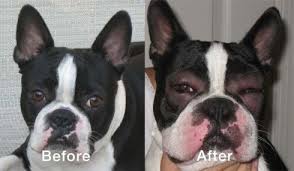
Bee, Wasp, and Hornet stings are just as bad for dogs as they are for people.  They usually cause localized swelling, but the whole body can swell including the mouth, throat, lips, and tongue.  Dogs may pant hard, vomit, experience diarrhea, show lameness if stung on a leg or foot, have difficulty breathing, and intense itching and pain.

It's difficult to prevent a sting, but you can reduce the risk by not allowing your dog to sniff at bees, checking under porches or decks for nests, and checking the ground for yellow jacket nests and disposing of the nests.  Be sure to keep Benedryl on hand if you live in an area with lots of bees or have a very curious dog.

If your dog has been stung, first, check your dog for stingers are carefully remove them.  Don't use tweezers because you may squeeze the sac and pump more venom into your dog.  Scraping a credit card across it usually works, just like with people.  Make a paste of baking soda and water and apply it to the sting, as it will help reduce swelling and reduce itching.  You can also give your dog benedryl at 1mg per pound of body weight, upto 2 mg per pound for larger dogs.  You should also call your vet, especially if your dog has a rapid heart rate, seems lethargic, or vomits.

You can also give them an oatmeal bath to help sooth their itchy, sore skin.  Try not to rub the sting much, just let them soak in it and rinse your dog very well.  I know my dogs aren't fond of soaking, so I pet them and massage them while the affected area is soaking.  Sometimes they are good with it and sometimes they try to jump out of the tub, but mine seem to do better if they are getting some positive attention.
Image result for dogs stung by beesImage result for dogs stung by beesImage result for dogs stung by bees Dogs that have been stung by bees, wasps, and hornets.


Mange
I have been lucky not to really have to deal with this one, but I do know about it so I will recognize it if it ever happens.  Mange is a skin condition caused by parasitic mites, and it can sometimes be transmitted to people.  It causes lesions, itching, and hair loss.

Demodectic mange is caused by demodex mites that inhabit the skin and hair follicles. They cause lesions, scabs, hair loss, and intense itching. It's usually diagnosed by doing a skin scraping or plucking hair.  General good health seems to help prevent this, as it seems demodex mites seem to flourish on less healthy or immune compromised dogs. It's treated with dips, special shampoos, and often prescription medication.  Take your dog to the vet if you suspect demodectic mange.

Sarcoptic mange is also caused by mites, but in this case they burrow deep into the skin, causing painful swelling, irritation,crusting on the skin, and itching.  Sarcoptic mange is highly contagious and your dog will need to be kept separate from others.  It's usually treated with prescription medication and special shampoo.  It's diagnosed by a physical examination of the skin and ruling out other causes of the skin irritation.  It can be chronic condition and there isn't really a way to prevent it.
Image result for mangeImage result for mange


Sources:
PetMD- Skin problems
PetMD - Insect bites
WebMD
Dog Care Knowledge
PetEducation

Sunday, July 17, 2016

IMHA: What I Wish I Knew

IMHA. What is it? Why should dog owners care about it? Let me start by saying that prior to April 17, 2015, I had never heard of IMHA, or Immune Mediated Hemolytic Anemia.  In some ways, I wish I still didn't know about it.  I am going to tell you the story of how I came to learn about IMHA, and how it changed my life, and my dog's life, forever.

Benelli as a puppy, climbing on the woodpile.  She was less than a year old. (2015)
 It was April 2015, and my boyfriend and I had a trip planned to the mountains to celebrate our anniversary.  My mom was staying at my house to take care of my teenage son and our two pups, Benelli and Remy.  A couple days before our trip, I noticed that Benelli had not finished all of her dinner, but I wasn't worried about it.  My dogs eat twice a day, and it wasn't unusual for Benelli to turn her nose at her food, especially when we were getting towards the bottom of the bag of kibble.  I store the kibble in a plastic airtight container, but it seems she could just tell when the food had been opened for a few weeks.  She was acting normally, playing with Remy and being her usual affectionate and silly self.

She was right around a year old in this picture (2013)
The next morning, Benelli ate most of her breakfast, but did leave several kibble behind.  I still thought nothing of it, since I assumed she was just being picky because we were nearing the bottom of the bag.  That evening, she again ate most of her food, but left some behind.  At this point, I was a little annoyed that she wasn't finishing her food, but didn't think there was anything wrong.  We left the next day for our trip.  I had long suspected that my boyfriend was going to propose on that trip on our anniversary, and I was looking forward to it.  We ended up coming home before he could propose.

My mom, who was staying at my house, called to let me know that she was really worried about Benelli, because not only was she refusing food, but had refused to drink and water and was acting lethargic.  As if that wasn't enough, my stepdad was sick and had been hospitalized, so we rushed home on April 17, 2015 so she could go to the hospital.  When we got home, Benelli did not even get up to greet us, though she pitifully wagged her tail from her position on the dog bed.  I knew then that something was really wrong, because she always greeted us at the door.  I had called my vet on the way home and made an appointment, so after a couple of hours home, we took her in for her appointment.

I had a really hard time saying no to her beautiful face,

At the veterinarian's office, the vet examined Benelli and noted that her gums and lips were very pale, and took some blood.  A few minutes later, the vet let us know that Benelli's red blood cell count was very low, and she needed specialty emergency care.  The vet called a local specialty hospital and arranged for Benelli to be admitted with a referral.  We hurried her to the specialty vet and they took her back within a few minutes.  We completed a lot of paperwork while waiting for her diagnosis.  The vet took us to a quiet corner and told us that Benelli had something called IMHA, or Immune Mediated Hemolytic Anemia, and that it was incredibly serious.  Red blood cells have the important job of carrying oxygen to cells all over the body and they also help remove carbon dioxide from the body.  When a dog (or person for that matter) is anemic, there are less red blood cells than normal to do the job.  When the anemia is immune mediated, it means that the body's immune system is attacking and destroying it's own red blood cells.  In Benelli's case, her body was producing antibodies to attack her red blood cells, treating them like it would if they were a virus or bacteria.

This was taken on her trip to the mountains with us, July 2014.

Benelli required canine blood transfusions. Prior to this trip to the emergency/specialty vet, I had never once thought about canine blood transfusions. There is a shortage of canine blood because owners don't know about canine blood transfusions or blood banks, and so don't have their pets donate.  Blood transfusions are very expensive, partially due to the low supply of available blood.  They gave Benelli two blood transfusions overnight, and called me around 6:00am on the morning of April 18, 2015 to let me know that her red blood count had increased a little bit.  This was welcome news, and I felt like things were heading in the right direction and she would be okay.  I've never been more wrong.

Another pic on our mountain trip in July 2014.  

When we went to visit her in the hospital a couple of hours later, Benelli was led out of the treatment area.  She wagged her tail, but was moving very, very slowly. It was obvious she was in pain, and it broke my heart to see her so excited to see us but unable to get to us as fast as she wanted.  We were led to a visiting room where we could sit with her and spend time with her.  The vet came in and asked my boyfriend and I to come out of the room.  We did, and left my teenage son in the room with Benelli.  The news was grim.  Despite the transfusions and medications, Benelli's red blood cell count had dropped lower than it was when she was admitted.  The vet confirmed that Benelli was in a lot of pain, as her organs were shutting down.  We talked about treatment options.  We could continue to transfuse blood and pump her full of medication, but she would have to stay at the hospital.  Treatment would be around the clock, but even so, her chance of survival was slim since her red blood cell count was dropping faster than they could be replaced, her major organs were shutting down, and she was in pain.  My mom and stepdad had arrived to visit and were in the visiting room with my son and Benelli.

This is Benelli (R) and Remy (L) on their first trip to the mountains together, July 2014.

I had already signed the papers authorizing euthanasia, because I couldn't stand to see her in pain.  I didn't want to end her life and wanted to keep fighting for her, but the vet explained that we were looking at thousands and thousands of dollars to put Benelli through hell, and she most likely wouldn't survive it.  Signing her life away on that sheet of paper was the single most hardest thing I have ever done in my adult life, and to this day, I feel guilty for it.  I know I did what was best for her, because I couldn't put her through pain and suffering.  So, we gathered around her on the floor, and spent time loving on her, telling her how much we loved her, and crying our hearts out.  After a couple of hours, the vet came into the room and administered the injections to put our sweet Benelli to sleep, and she crossed the rainbow bridge in our arms.  We spent a little more time with her, before going home in a haze of grief and loss.  About a week later, the hospital called to let us know her urn with her ashes was available for us, and my (now-husband) brought her home where she belongs.
This was taken about two weeks before she died. I often like to just snap pictures
while hanging out in the yard with my pups.  I had no idea this would be the last picture of her before she would be
on her deathbed.  I do have some pictures of her with family,  taken in that little room
where she died, but we would prefer to remember her this way.


I spent a lot of time researching IMHA, and trying to figure out what symptom I missed or how I could have known that she had something seriously wrong.  The only early symptom was that she wasn't finishing her food, and I attributed it to her normal behavior at the end of the bag.  Other symptoms did develop, but I wasn't aware of IMHA and didn't recognize them.  I hope you never has the misfortune of crossing paths with IMHA, but these are the symptoms so you will be more informed than I was.  Perhaps it will make a difference in the life of your furbaby.


  • Weakness
  • Lethargy
  • Poor appetite
  • Fainting
  • Exercise intolerance
  • Vomiting
  • Rapid breathing
  • Diarrhea
  • Increased thirst and urination in some dogs
  • Fever
  • Jaundice
  • Rapid heart rate
  • Melena (Black feces due to hemorrhage in gastrointestinal tract)
  • Petechia (red, purple spots on the body due to minor hemorrhages)
  • Ecchymoses (skin discoloration in patches or bruises)
  • Joint pains
There is a lot more to IMHA than I'm covering in this blog - like how some breeds are predisposed and females are more likely to suffer from it than males.  I urge you to read up on it so you can catch it early if it happens to your dog, and hope you never need that knowledge.  The links listed under "Sources" below are great places to start.


Sources:

Friday, July 15, 2016

Heat Stroke: Would You Recognize It? (Prevention & Treatment)

You've probably heard not to leave your dog in the car, and even heard of the many stories of owners who have done that and had their dogs die.  Sometimes, the dogs are rescued in time.  You should never leave your dog in the car, even if you leave the windows down or leave the car running with the A/C on, or you're parked in the shade.    There have been several reports of citizens or police rescuing dogs left in hot cars, and these dogs survived, but many don't.
Pensacola Florida, July 1, 2016
Wrentham, Massachusetts, June 27, 2016
Merriam, Kansas, July 11, 2016

If you can't take your dogs with you into every store or place you plan to visit, then leave your dog at home!


In addition to being careful about not leaving your dog in a car, there are other dangers to dogs related to heat.

Some areas are very humid, particularly in the southeast and mid-atlantic regions of the US.  Humidity affects pets just like it does humans, and can lead to heat stroke.  When dogs pant, it helps to remove moisture from their lungs to help take heat away from their body.  When humidity is too high, dogs aren't able to effectively remove the moisture and heat.

Exercise is very important, but on hot/humid days, limit or reduce the amount of exercise and also try to limit it to the early morning or late evening hours, when it is cooler.  Not only will both you and Rover enjoy your walk or game much more, but it will help reduce the chances of your dog overheating.  If you walk on pavement, be aware that if it's too hot for you to put the back of your hand on the pavement for seven full seconds, it's too hot for your dog to walk on.


Fans can help, but they aren't ideal because a dog sweats through his feet!  While the breeze will feel good to your dog, it may not actually cool him off much.  That being said, when we are outside I do have an outdoor fan running and my dogs do like to lay in front of it - often with their feet towards it.  There's nothing wrong with using a fan, but don't count on it to be enough to keep your dog cool by itself.

When your dogs are outside, make sure they have water and shade.  If possible, think about putting ice cubes in their water.  I like to use cubes made from frozen broth as well, because the flavor helps encourage my dogs to drink more.  Shade from tarps, trees, awnings, or open air tents are the best because they allow air flow.  Dog houses actually trap the heat and won't do anything to cool your dog.   Water loving dogs may love to run through a sprinkler (you can make a soft one using a pool noodle!) or in a plastic wading pool filled with cool water.
mesh sun shade
open air flow tent


basset in plastic pool
dog cooling off in pool


frozen kong
Give cool treats such as broth ice cubes in their water, or freeze mashed bananas and peanut butter in their kong.  You can try plain greek yogurt, peanut butter, and a fruit like blueberries, bananas, apples, etc frozen in a kong as well.  You can also freeze green beans and carrots and give them as a low calorie cold treat.  Frosty Paws are a nice cold treat, too.   I also help my puppes keep cool by making puppy popsicles, and I also freeze the 3 Ingredient Canine Cookies and give them to my pups frozen - they stay soft even when frozen!

puppy popsicles 

3 ingredient canine cookies

Have a plan for power outages because they do happen and sometimes it's more than for just a couple of hours.  It's just important to make sure your dog stays comfortable as it is for you.  Your plans may include having a list of pet-friendly hotel/motels outside of your immediate area (maybe the next town over), a list of friends or relatives in various nearby areas that would be willing to let you and your pet stay with them, at least two dog boarders in different nearby areas (within maybe 15 miles or so) where you would be comfortable leaving your pet as long as the boarder has power (and have your dog registered with them and preferably stay in a non-emergent situation so you will know you your dog does with boarding).  Also, consider contacting your vet when you lose power - they may have power (and likely a backup generator) and be able to board your dog.

Know the signs of canine heat stroke. I wasn't aware of all of these before writing this blog.
Signs of heat exhaustion and heat stroke are:

  • heavy/excessive panting
  • glazed eyes
  • difficulty breathing
  • excessive thirst
  • lethargy
  • fever (over 103 degrees)
  • excessive drooling
  • dizziness
  • lack of coordination or falling
  • dark red or purple tongue
  • seizure
  • vomiting, including vomiting blood
  • paid heart rate
  • irregular heartbeat
  • unconciousness
  • less urine than usual or not urinating
If you think your dog is suffering from heat stroke, move your dog into the shade or if possible, and air conditioned area.  Apply ice packs or cold/frozen towels to her body, and let her drink small amounts of water or lick ice cubes.  My beagle easily overheats and most of the time, doesn't want to drink water.  I use a small syringe from the local pharmacy to squirt a little bit of water in his mouth to help him cool down and hydrate. Run cool (but not cold) water over his body. Call your vet right away if you suspect heat stroke, as your dog may need urgent medical attention including IV fluids!

Some breeds are more susceptible to heat stroke, including those with very heavy coats such as alaskan malamute, husky, sheepdog, irish wolfhound, samoyed, st. benard, newfie, and akitas.  Also,  dogs with pushed in faces such as pug, bulldog (french and english), boston terrier, boxer, chow chow, pekingeses are at an increased risk of heat stroke.  Any overweight or obese dog of almost any breed is also at an increased risk.

Sources:
Humane Society
ASPCA
PetMD
iHeartDogs

Thursday, July 14, 2016

Top Five Reasons To Adopt A Shelter/Rescue Animal


ADOPT, Don't Shop!


Did you know that most dogs sold in pet stores come from over-crowded puppy mills?  So, too, do most of the puppies you see advertised online or in newspaper classifieds.  Puppy mills are a for-profit operation whose sole purpose is to churn out puppies at the lowest cost to be sold at a higher price.  This is done without regard to the mama dog's health, and puppies are often lacking proper nutrition, socialization, and vet care.  Dogs are bred without regard to genetic conditions, often producing puppies that have issues down the line, such as hip dysplasia and allergies.  Once the mama dog is no longer useful for breeding, they are usually killed (not always humanely), sold or given away to be used as bait dogs in illegal dog fighting operations, or set loose on the streets to become a stray.


My top five reasons why you should ADOPT and NOT SHOP (aka DON'T BREED OR BUY while shelter animals DIE):


#5: Adopted Animals often are at least partially house-trained.  While adopting a shelter dog doesn't guarantee your new pet is housetrained or won't have accidents in the house as they get used to your home and schedule, it's much more likely for an adopted dog to already have at least some manners.  Many also know commands such as "sit", "stay", and "come", making your efforts to train your new family member much easier. 


#4 Adoption is better for your finances than buying a puppy mill or breeder's dog.  Sure, adoption fees typically range between $50-$400 to adopt a dog from a rescue or shelter.  That cost covers the spay or neuter (typically $100-$250), current on all vaccinations ($50-100), and the room and board (other medical, food, toys, etc) plus helps the rescue or shelter cover other costs.  Some shelters and rescues also include the cost of micro-chipping and registration in the adoption fee (~$35-50).  The fact is, the adoption fees often don't even cover the cost of care that your new pet has received, but along with donations received from others, will help keep the operation running and help save more lives.

#3: Rescues & Shelters offer variety.  Some rescues are breed-specific, and that's a good thing if you are looking for a specific breed.  If you aren't sure what breed you want, a non-breed-specific rescue or a shelter is the perfect place to go.  You will be able to see dogs of all sizes, colors, shapes, breeds, and temperaments.  Shelter staff will usually be able to tell you things like if that dog gets along with other dogs or if they have quirky preferences, like my basset/beagle mix, Remy, who generally doesn't like dogs that are bigger than her.  Many rescues are able to foster their dogs, so they will be able to tell you if the dog you are interested in does well with small kids, prefers a quiet home, needs a tall fence, gets along with other dogs or cats, etc.  


#2: When you adopt a shelter or rescue pet, you are saving a life.  Actually, you are saving TWO lives.  The life of the pet you are adopting, but also, by opening up that spot, an animal that would be euthanized may have a chance to find their furever home.  

#1: Because it's the right thing to do.  Everyday, thousands of shelter animals are killed simply because they are homeless and the shelter is full.  Hundreds of shelter dogs and cats die every hour in the United States.  You can't save them all, but you can make a difference in one (or more!) animal's life.  Many times, these animals are in shelters through no fault of their own.  Common reasons animals are surrendered are move, divorce, people who buy or adopt dogs without consulting other adults in the family, difficulty potty-training (due to the humans not knowing the best way or teaching the dog), the dog is more responsibility than the owner thought it would be, owners can't afford to feed their dog, etc.
 
If you can't adopt an animal, please consider donating (wet or dry food, collars/leashes, toys, money, etc) to your local shelter or rescue of your choice.


Benelli was adopted through our local SPCA, and Remy was adopted through an SPCA several counties away. Otis was adopted through Love Mutts Rescue, a local (NC/VA) non-profit non-breed specific animal rescue (dogs and cats).

Sources:
RedRover.org
Humane Society